
News

Weed of the Month: Bittersweet Nightshade
For this Weed of the Month, we’re bringing bittersweet nightshade into the light. Here are some tips for identifying and managing infestations to protect your family, pets, and livestock from this toxic invader.
.png)
Investigating Colorado Tick Fever Virus (CTFV) transovarial transmission in Dermacentor andersoni in Wyoming
Ever wondered about Colorado Tick Fever Virus pathogen transmission pathways and prevalence in our community? No Problem. We’ve got you covered. Check out the results from our team’s recent outing and research presentation, “Investigating Colorado Tick Fever Virus (CTFV) transovarial transmission (TOT) in Dermacentor andersoni in Wyoming!
.png)
2025 End of Year Report
"Our mission is to protect, manage, and restore ecosystem integrity through comprehensive invasive species and vector-borne disease management - for the benefit of both ecological and human health. While this may sound like a lofty goal, it’s one we pursue every day with dedication and purpose. At the District, delivering the highest level of service to Teton County isn’t just our mission - it’s what we do. In this report you’ll see the many ways our small but mighty team of nine full-time staff and sixteen employees works tirelessly to care for this community. Beyond our “regular responsibilities, we are also proud to have hosted the 81st Wyoming Weed & Pest Annual Conference in October, welcoming more than 150 friends and colleagues from across the state. We extend a special thanks to the Jackson Hole Travel and Tourism Board and the Sustainable Business Leaders program for their generous support, which helped make this outstanding event possible. From integrated invasive species management and West Nile virus prevention, to coordinating with Working Dogs for Conservation in support of our longest-running program - the Snake River Project (est. 2001) - to launching our newest initiative, Tick Blitz, this report highlights the many ways TCWP is working for you. Our team is made up of passionate, driven individuals who care deeply about their neighbors and the ecosystems we all depend on. I’m proud to share their work with you and invite you to learn more, get involved, and discover how we can work together to make Jackson Hole healthier and more resilient today, tomorrow, and for generations to come." - Erika Edmiston, District Supervisor
.png)
How to #PlayCleanGo this Winter Season!
Winter recreation in Teton County is a way of life. From backcountry skiing and snowmobiling to fat biking and snowshoeing. But even when the landscape looks frozen and pristine, invasive species can still hitch a ride. Seeds and plant fragments from invasive weeds often cling to boots, skis, and snowmobile tracks, dogs, and vehicles. When snow melts and mud season begins, those seeds are deposited into vulnerable trailheads, parking areas, and wildlife habitat. Practicing PlayCleanGo year-round helps protect the places we love before damage takes root!
%20(3).png)
Diversifying the Capacity of the District’s Lab to Provide Genetic Identification of Invasive Plants
Historically, the Teton County Weed and Pest Lab served primarily the vector surveillance side — the PEST side — of Weed & Pest. A vital component of any effective vector surveillance program is, of course, species identification (microscopy). At one point, that was the lab’s primary function. As my colleague Mikenna Smith, Entomologist at TCWP, likes to say, the lab was once “a closet with a microscope.” But over time, Mikenna transformed that closet into a functioning laboratory — evolving it to meet the growing needs of a modern vector surveillance program. This included adding qPCR-based pathogen testing and implementing a tick surveillance program.
.png)
Concerns of Impacts to Weed Biocontrol from Mosquito Abatement
Thank you to Mikenna Smith, Teton County Weed and Pest Entomologist, for her contributions to this article from her recent research presentation. Biocontrol and Mosquito Control: Are They at Odds? As an entomologist working in both biological control (biocontrol) of weeds and mosquito abatement, I often find myself in a unique position to explore how these two practices interact. When researching whether mosquito control affects weed biocontrol agents, I found surprisingly little direct research. However, there’s a lot of literature on how mosquito pesticides affect non-target insects in general. That’s what I’ve used to guide this discussion.
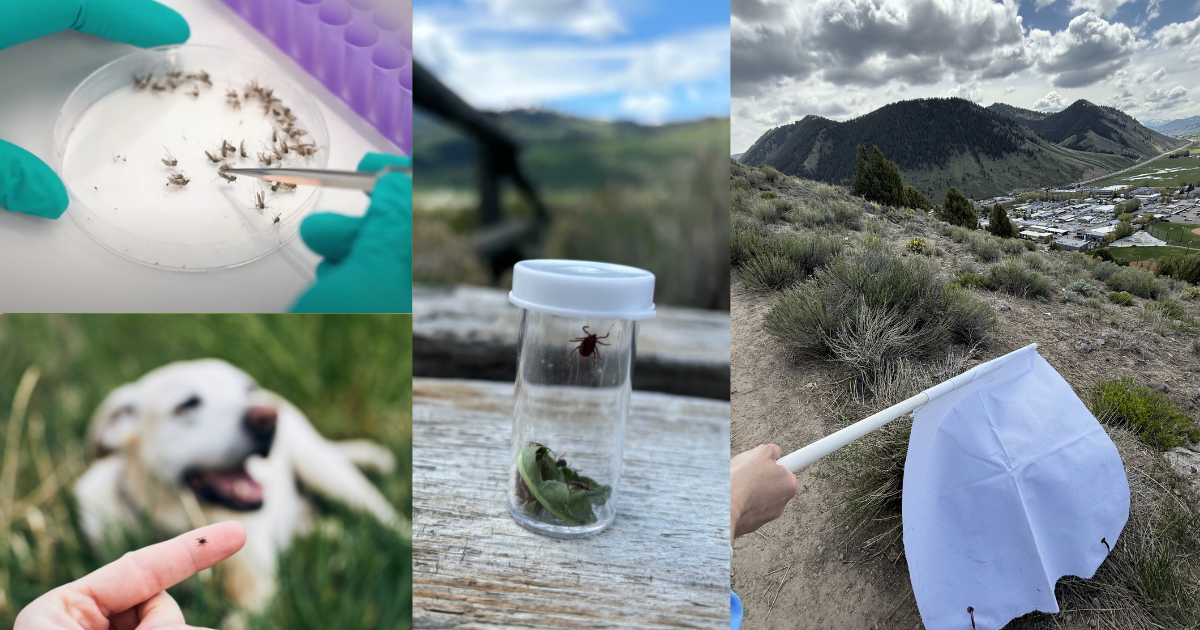
2025 End of Season Tick Surveillance Report + Understanding and Tackling Knowledge Gaps Surrounding Ticks in Wyoming
Thank you to Mikenna Smith, our staff entomologist, and Kelsey Mitchell, our staff biologist, for their contributions to the JH Wildlife Symposium presentation, 2025 Tick Surveillance results, and this article.
%20(2).png)
Detecting Tick-Borne Viruses in Wyoming: Better Testing, Better Protection
When ticks test negative for pathogens, how can we be sure the results aren’t compromised by degraded sample quality and technical errors? That question drove a recent project by our team to improve the diagnostic accuracy for tick-borne viruses—and it’s already making a difference for Teton County public health! Thank you to Kelsey Mitchell, Teton County Weed and Pest Biologist, and Mikenna Smith, Teton County Weed and Pest Entomologist, for conducting this research and in preparing this presentation that drives solutions for our community!
%20(1).png)
Mosquito Abatement in West Central Wyoming
Wyoming was the first state to grant women the right to vote and hold public office. It is also home to Yellowstone National Park, the first national park in the U.S. With just 590,000 residents, Wyoming remains the least populated state in the country. Its second nickname, “The Cowboy State,” reflects its long-standing ranching history.Much of Wyoming’s landscape is well-suited for livestock production. More than two-thirds of the land is dedicated to grazing, with cattle being the dominant livestock, followed by sheep and hogs to a lesser degree. The state also produces large quantities of hay.While crop production is less common than grazing, Wyoming farms grow sugar beets, dry beans, seed potatoes, and grains such as wheat, barley, oats, and corn.Wyoming is a rural and arid state, with most of its precipitation falling as snow. In the summer months, water stored in rivers becomes vital for irrigating agricultural lands. Of all irrigated land used for agriculture in Wyoming, flood irrigation accounts for over two-thirds of irrigation practices. However, flood irrigation creates ideal breeding conditions for mosquitoes—especially across large acreages that are often adjacent to small communities. Many of these areas lack formal mosquito abatement programs, posing challenges to both public health and agriculture.

Weed vs. Invasive Plant
We’re often asked: what’s the difference between weeds and invasive plants? They’re both unwanted, often tough to remove, and we offer tips for control and extermination for both. With so many overlaps, it can be confusing to tell the difference. We’re here to help spell out what makes a weed a weed, what makes an invasive plant an invader, and how to tell the difference.